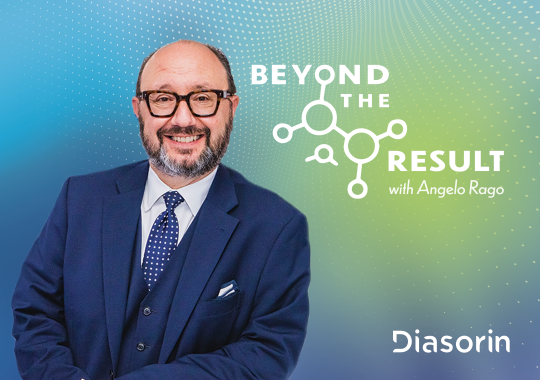
One theme running through three recent Beyond the Result podcast episodes is that diagnostic stewardship isn’t just about tests: it’s about people, outcomes, and the way healthcare truly functions.
Guest experts on episodes 7, 8, and 9 of the Diasorin podcast include: Scott Wallace, JD, MBA, CEO of the Health Value Academy and Associate Professor at Dell Medical School at the University of Texas at Austin; Donna Wolk, MHA, PhD,D(ABMM), Division Chief, Molecular and Microbial Diagnostics and Development at Geisinger Health; and Allison Chambliss, PhD, D(ABCC), Senior Leader, Clinical Microbiology, UCLA Health.
We encourage you to watch or listen to each podcast, but for a quick overview, here are some highlights from the conversations.
Starting with what patients value
Scott Wallace begins by challenging the way we define “value” in healthcare. Instead of focusing on cost cutting, which is what many assume value-based care means, he describes a much more patient-centered idea: value equals the improvement in outcomes that matter to patients, divided by the cost of achieving those outcomes.
He and his team spend time listening to patients describe their experiences, such as what a “good day” looks like when living with a chronic condition, what keeps them up at night, and what fears creep in when symptoms flare. From these conversations, he says, three consistent themes always emerge: patients want to retain their capability, experience greater comfort, and feel a sense of calm throughout their care journey.
And here’s where diagnostics matter so deeply. As Wallace puts it, if the diagnostic foundation is shaky, everything built upon it (treatment choices, medications, procedures) suffers. Inaccurate or delayed diagnostics don’t just create inefficiency; they create waste and, in some cases, real harm.
He points to a vivid example: the Martini-Klinik in Germany, where the pathology lab is integrated directly into the operating room. Surgeons receive immediate margin assessments, make informed decisions without delay, and achieve world‑leading outcomes for prostate surgery. It’s a powerful demonstration of how diagnostics and clinical workflow can, and should, work hand in hand.
Hear this and more from Scott Wallace on Beyond the Result Episode 7.
Taking stewardship beyond hospital walls
Where Wallace speaks to the philosophical “why,” Dr. Donna Wolk brings the “how,” especially in environments that don’t resemble traditional hospital labs.
She describes urgent cares, micro-hospitals, and retail clinics as the “Wild West” of diagnostics: busy, unpredictable, often staffed by non-laboratorians, yet essential to community-level care. And in a value-based system like Geisinger’s, those sites must deliver fast, accurate, and actionable results.
What’s impressive about Geisinger’s approach is just how standardized everything is. Dr. Wolk explains that the same testing platforms, clinical algorithms, protocols, and electronic health record documentation processes are used across the entire network. This allows data to flow seamlessly and lets the central lab oversee everything from quality to turnaround times, even when tests are performed far from the core facilities.
This model paid off dramatically during the COVID‑19 pandemic. Fortunately, in 2016, Geisinger began preparing for a future flu pandemic by developing a decentralized testing strategy. When COVID arrived, they were ready: inpatient turnaround times averaged just three hours, while outpatient times hovered around thirteen. Patients got rapid results, clinicians could act quickly, and patient satisfaction remained high.
Dr. Wolk stresses that while data is crucial, communication is equally important. Weekly check‑ins, interdisciplinary meetings, and patient conversations make stewardship real and protocols stick. She also urges diagnostic manufacturers to rethink their role. Rather than releasing tests into the world and hoping adoption follows, the industry should help gather evidence earlier, during clinical trials, to demonstrate diagnostic and economic value. Payers, she notes, want real proof, not just technical specifications.
Hear this and more from Dr. Wolk on Beyond the Result Episode 8.
Building stewardship programs that can grow and evolve
In this episode, Dr. Allison Chambliss offers an inside look at what it takes to build a lasting stewardship program at one of the country’s largest academic medical centers.
At UCLA, stewardship isn’t a side project; it’s woven into operations through a clear structure. Dr. Chambliss describes a three‑layer ecosystem: subcommittees dedicated to specialized areas like infectious disease or genetics, a central stewardship committee of about fifteen members, and an oversight group composed of chief medical officers and system leaders.
What keeps everything moving is a dedicated program manager who coordinates reporting, documentation, and follow‑up. It sounds bureaucratic, but Dr. Chambliss makes it clear that the structure creates clarity, not bottlenecks. And in urgent moments, such as outbreaks or audits, the team can pivot quickly, temporarily leaving the normal process behind to protect patient care.
One of the most compelling parts of Dr. Chambliss’s perspective is her advice for smaller institutions: don’t try to build an entire program right away. Rather, start with a single project and identify a specific area where better data or improved ordering practices could make a difference. And most importantly, find a clinician champion, someone who believes in the effort and can help the lab bring change to the front lines. Over time, those early wins build credibility and support the creation of stronger stewardship infrastructure.
She also notes that stewardship is evolving rapidly with the growth of AI. UCLA’s Artificial Intelligence Council is beginning to evaluate AI-enabled diagnostics and decision support, suggesting a future where stewardship committees oversee not just tests, but the algorithms behind them.
Hear this and more from Dr. Chambliss on Beyond the Result Episode 9.
A shared vision for what stewardship can become
Despite speaking from different vantage points, academic medicine, a large integrated health system, and a value‑based care institute, all three leaders arrive at a shared conclusion:
Diagnostics is not just a technical step in care. It is the beginning of value.
Across these conversations, the message is both practical and optimistic. Stewardship succeeds when labs and clinicians work side by side. Diagnostic stewardship isn’t only about improving testing. It’s about creating a healthcare system in which every test, every workflow, and every decision leads to better capability, comfort, and calm for patients.
And that’s a future well worth building.
We are still recording new episodes for the Beyond the Result podcast.
Our upcoming episodes will include guests such as:
- Stephanie Whitehead, Vice President of Pathology at University Health and Value-Based Care Leader
- Melody Nelson, Assistant Director of the Clinical Chemistry Core Laboratory and Section Director of Point of Care services at the University of Kansas Health System
Both will be speaking on tactical approaches to diagnostic stewardship as a tool in value-based care. Whether you’re a healthcare executive, decision-maker, or laboratorian, “Beyond the Result” is your front-row seat to the future of diagnostics because better diagnostics means better care.
Listen here or wherever you find your podcasts.
Sign up to be notified when new episodes become available.